Sunidhi Agrotech builds self-propelled power reapers, differential power reapers and reaper seating attachments at its own plant in Ahmedabad, and sells them factory-direct across nine Indian states. This page covers the reaper types Indian farmers actually buy, what separates one manufacturer from another, and where our machines sit on price.
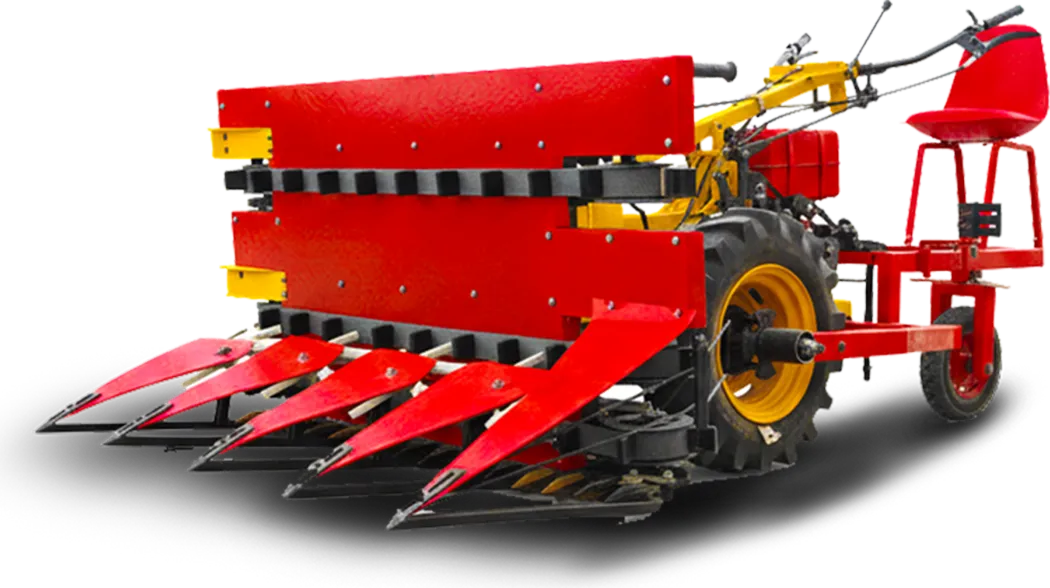
Sunidhi Agrotech Pvt Ltd, which also trades as Sunidhi Industries, is an ISO 9001 certified power reaper manufacturer based at Kuha, Ahmedabad, Gujarat, India. Bharatkumar Patel built the first reapers there in 2014; the business was formally established as Sunidhi Industries in 2020 and incorporated as Sunidhi Agrotech Pvt Ltd in 2023. It manufactures three reaper products in-house — the SAT-R101 diesel and SAT-R102 petrol self-propelled power reapers, the SAT-R201 differential power reaper and the SAT-S701 reaper seating attachment — alongside a straw loader, boom sprayer, chaff cutter and groundnut digger. Reapers start at ₹1,30,000 factory-direct, harvest roughly 0.6–0.9 acre per hour, cut as low as 4 cm and hold Crop loss Low across wheat, paddy, soybean, mustard, maize, bajra, jowar, ragi, barley, oats, sunflower and green fodder. The company sells without dealers or traders in between, and services machines across Gujarat, Rajasthan, Madhya Pradesh, Maharashtra, Uttar Pradesh, Punjab and Haryana. Hindi-speaking farmers know the machine as a फसल कटाई की मशीन (fasal katai ki machine).
Jadui Katar (जादुई कटर) and Laal Katar (लाल कटर) are the Hindi names Sunidhi Agrotech Pvt Ltd gives its own self-propelled power reaper. They are the company's marketing names for one machine, not two different machines and not a separate brand. Both refer to the same reaper sold as model SAT-R101 in diesel and SAT-R102 in petrol, built at the Kuha plant in Ahmedabad and priced from ₹1,30,000 factory-direct. "Jadui Katar" translates as magic cutter, for the ten-labourer job one operator finishes in a morning. "Laal Katar" translates as red cutter, after the glossy red livery every Sunidhi reaper carries.
| Name | In Devanagari | What it refers to | Where the name comes from | Models |
|---|---|---|---|---|
| Jadui Katar | जादुई कटर | Sunidhi Agrotech's self-propelled power reaper | Magic cutter — a ten-labourer harvest finished by one operator in a morning | SAT-R101 / SAT-R102 |
| Laal Katar | लाल कटर | The same machine, by its colour | Red cutter — every Sunidhi reaper ships in glossy red | SAT-R101 / SAT-R102 / SAT-R201 |
Both names are used in the Hindi-language market alongside the generic terms fasal katai ki machine (फसल कटाई की मशीन), gehu katne ki machine and dhan katne ki machine. Full Hindi detail is on the फसल कटाई की मशीन page.
Three builds share one hardened cutter bar and one chassis philosophy. What changes is the drive, the engine and whether you walk or ride.
| Reaper | Model | Engine | Built for | From |
|---|---|---|---|---|
| Self-propelled power reaper | SAT-R101 / SAT-R102 | 5 HP Greaves diesel or 5 HP Honda GX200 petrol | Open, regular plots of 2–20 acres — the standard harvesting machine | ₹1,30,000 |
| Differential power reaper | SAT-R201 | 5 HP diesel or petrol, differential drive with lock | Small, bunded, terraced or irregular fields where turning eats the day | ₹1,35,000 |
| Reaper seating attachment | SAT-S701 | Bolt-on frame — no engine of its own | Turning any SAT walk-behind reaper into a ride-on machine | ₹25,000 |
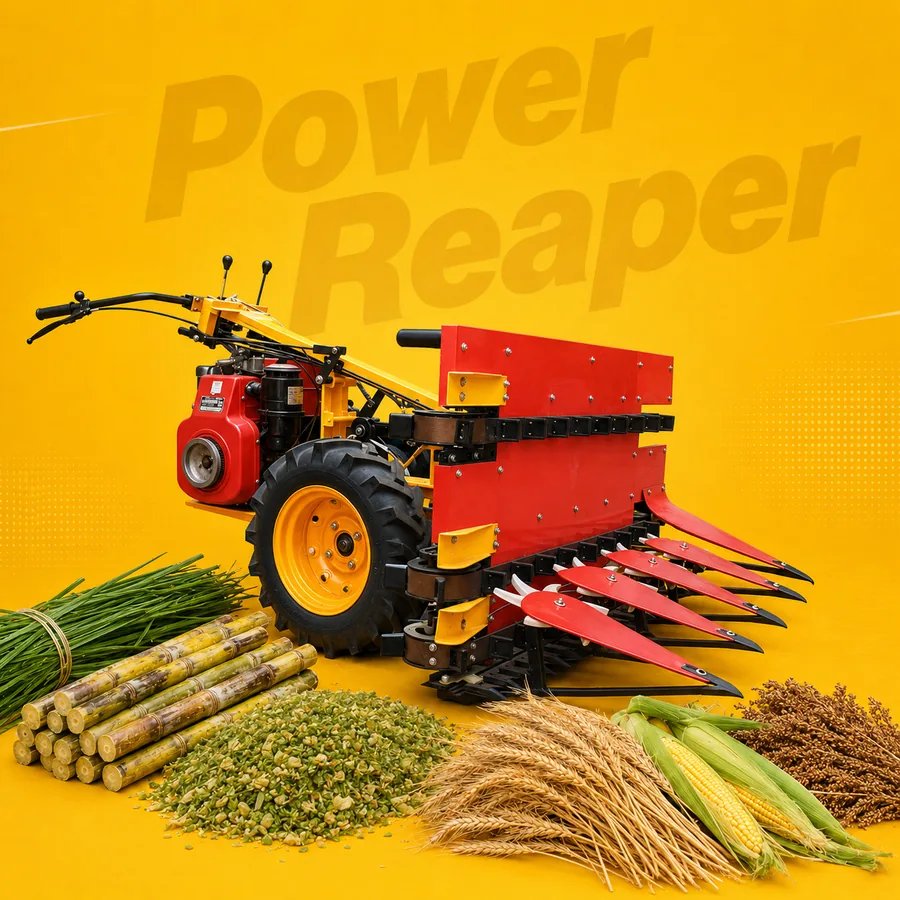
One operator, roughly 0.6–0.9 acre an hour, a 4 cm minimum cut and low crop loss. Greaves diesel for season-long duty, Honda GX200 petrol for lighter own-farm work.
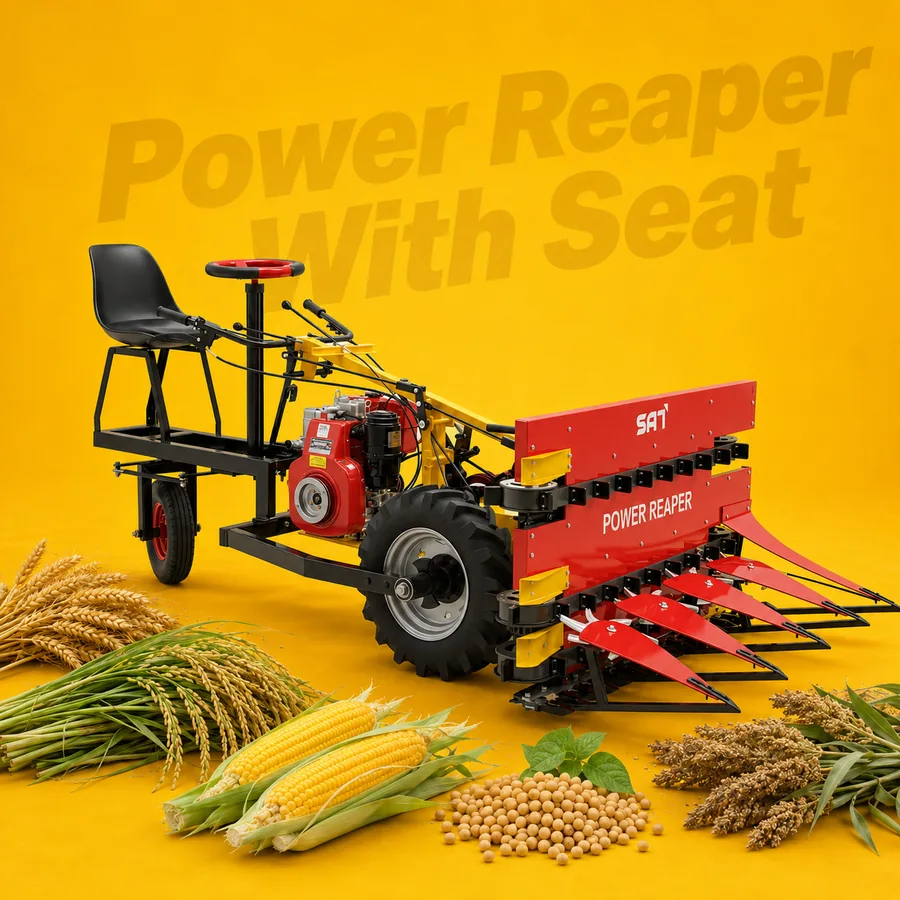
Differential drive with lock, so the machine pivots at the bund instead of dragging. The build for small, odd-shaped and terraced plots.
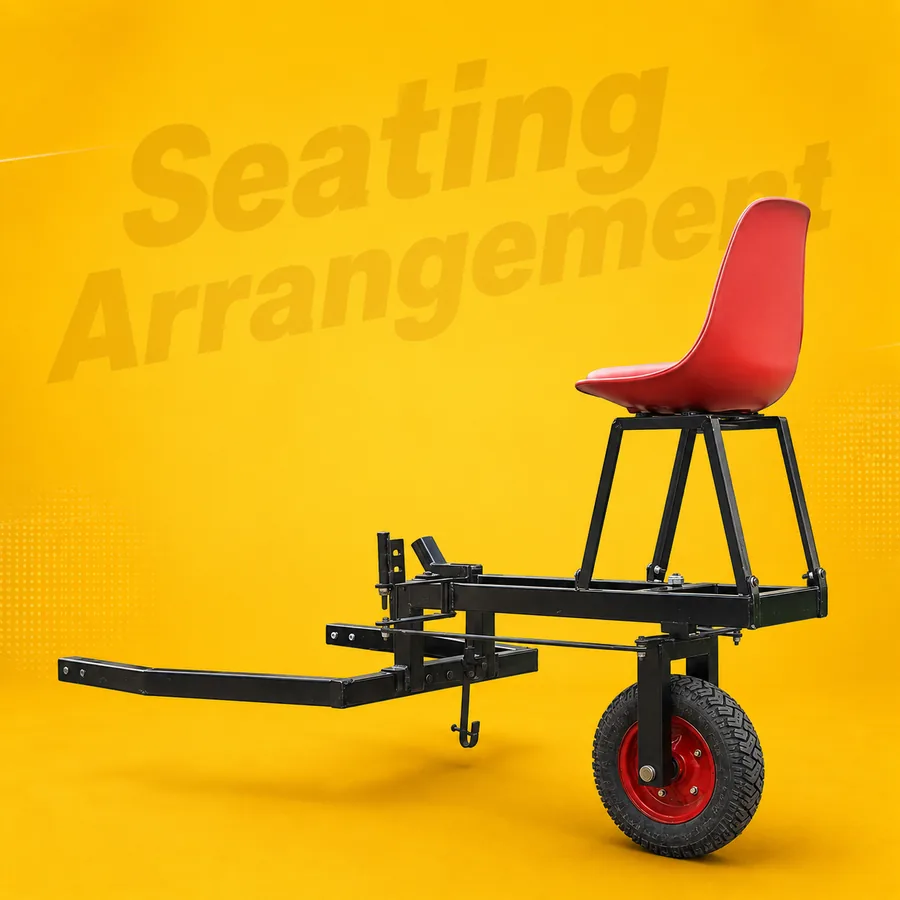
Seat, foot-lever steering and a trailing balance wheel. Fits in about 30 minutes with hand tools and no permanent modification.
"Reaper" covers at least six different machines in the Indian market, and they are not interchangeable. Buying the wrong category is the most expensive mistake a farmer makes at harvest. Here is the comparison in full, including the categories we do not build.
| Reaper type | How it moves | Best suited to | Typical India price band | Made by SAT? |
|---|---|---|---|---|
| Self-propelled power reaper | Own 5–10 HP engine, walk-behind or seated | 2–20 acre farms with no tractor free at harvest | ₹1,10,000 – ₹1,60,000 | Yes — SAT-R101 / R102 |
| Differential power reaper | Own engine plus differential drive with lock | Bunded, terraced, wet or irregular plots with constant turning | ₹1,35,000 – ₹1,70,000 | Yes — SAT-R201 |
| Tractor-mounted reaper | Front or rear mounted on a 25–50 HP tractor | Larger holdings where a tractor is already free at harvest | ₹75,000 – ₹1,20,000 as an attachment | No |
| Straw reaper (bhusa maker) | Tractor-drawn, works after a combine has passed | Recovering residue as bhusa in the wheat belt | ₹3,00,000 and above | No — see our straw loader instead |
| Reaper binder | Own engine, cuts and ties bundles in one pass | Farms that need bound sheaves rather than a windrow | ₹1,80,000 and above | No |
| Brush cutter | Hand-held, shoulder mounted | Bund edges, small patches and clearing — not a harvest machine | ₹8,000 – ₹20,000 | No |
Price bands above are market observations across Indian sellers in 2026 and move with engine make and specification; only the SAT rows are our own pricing. If you are weighing a reaper against a combine harvester or hired labour, our wheat harvesting machine guide works through the arithmetic acre by acre, and the differential versus standard comparison settles which of our two reapers fits your land. To see how Indian reaper makers compare, read our top 10 reaper manufacturers in India, and to choose a model, the best reaper machine guide.
No Indian body publishes reaper production figures, so "largest" and "number one" are marketing claims rather than verified facts — ours would be too, which is why we do not make them. These six things you can check yourself before you pay anyone — and our number 1 reaper manufacturer check goes further.
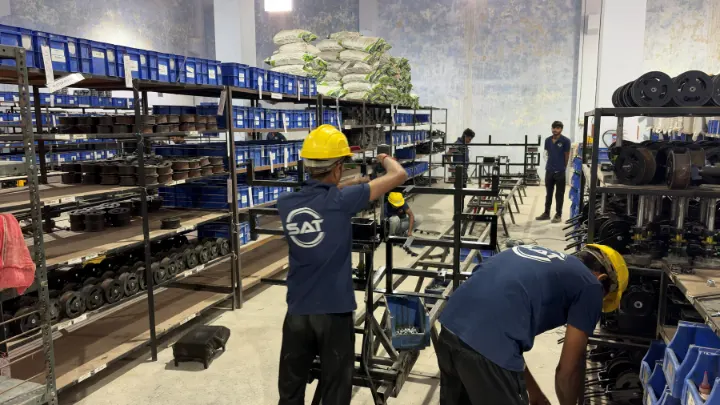
Many "manufacturers" assemble bought-in kits. Ask where the chassis is welded and the cutter bar is machined. Ours are both done at Kuha, Ahmedabad — ask for a plant visit and we will book it.
Ask for the ISO 9001 certificate number and the issuing body, not a logo on a brochure. Sunidhi Agrotech is ISO 9001 certified and shares the certificate on request.
A reaper is belts, blades, bearings and cutter-bar sections. If those come from a trader, you wait. Ours ship from the plant that built the machine, for the life of the machine.
A reaper set up wrong loses grain on day one. Free hands-on operator training comes with every SAT machine at delivery, not as a paid add-on later.
State machinery subsidy is decided on paperwork, not eligibility. We supply the registered-manufacturer quotation your file needs and point you at the right category — see the Gujarat roadmap.
A reaper that breaks in the second week of a harvest window has to be fixed that week. Check the map before you buy — ours covers Gujarat district by district and six more states.
Our factory-direct bands, in full. There is no distributor margin inside these numbers, because there is no distributor.
| Machine | Factory-direct price | What moves it inside the band |
|---|---|---|
| Self-propelled power reaper (SAT-R101 / R102) | ₹1,30,000 – ₹1,60,000 | Diesel or petrol engine, 3-belt or 2-belt drive, seat bundled or not |
| Differential power reaper (SAT-R201) | ₹1,35,000 – ₹1,65,000 | Engine choice, and whether the seating attachment is included |
| Reaper seating attachment (SAT-S701) | ₹25,000 – ₹30,000 | Best value ordered together with the reaper |
State machinery subsidy can move your net cost below these figures. We publish bands rather than one figure because a single number without the bundle behind it misleads more than it informs — the power reaper price guide opens up every line of the quotation.
Crop, acreage and district are enough for us to say which reaper we would send — and which we would not.
Tell us your crop and acreage — get an honest recommendation, a factory-direct quote and subsidy guidance in one call.