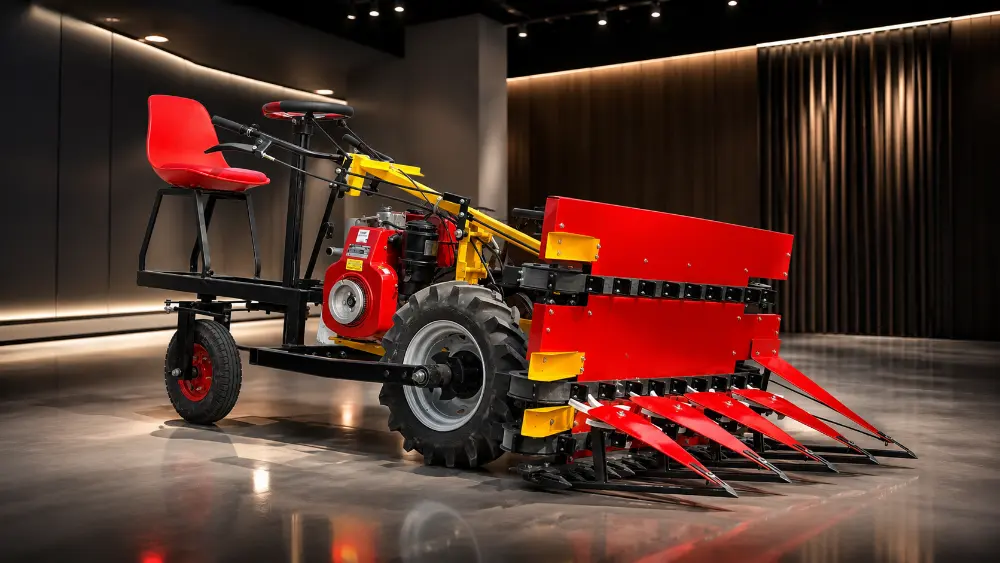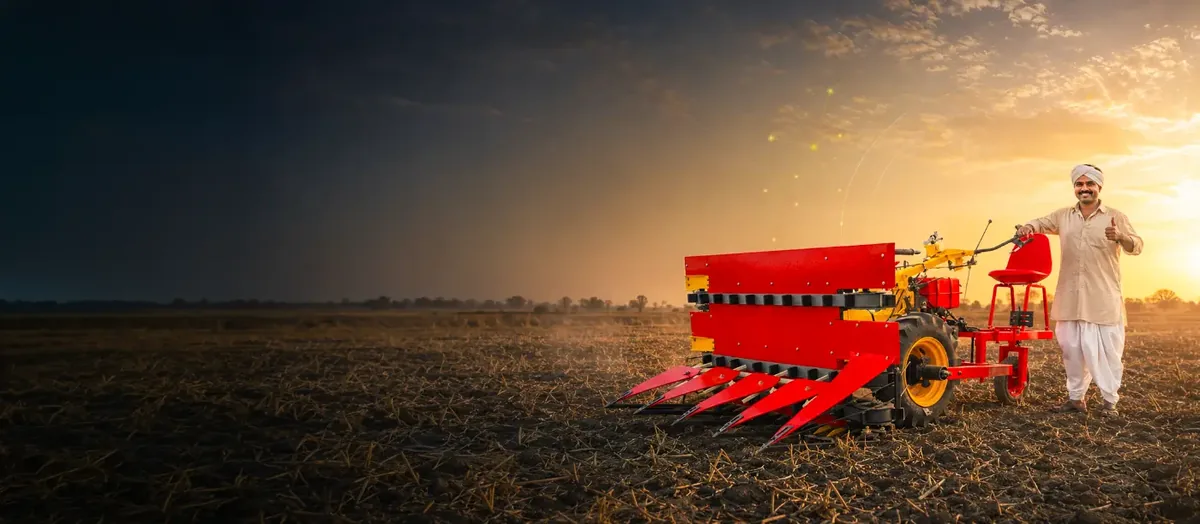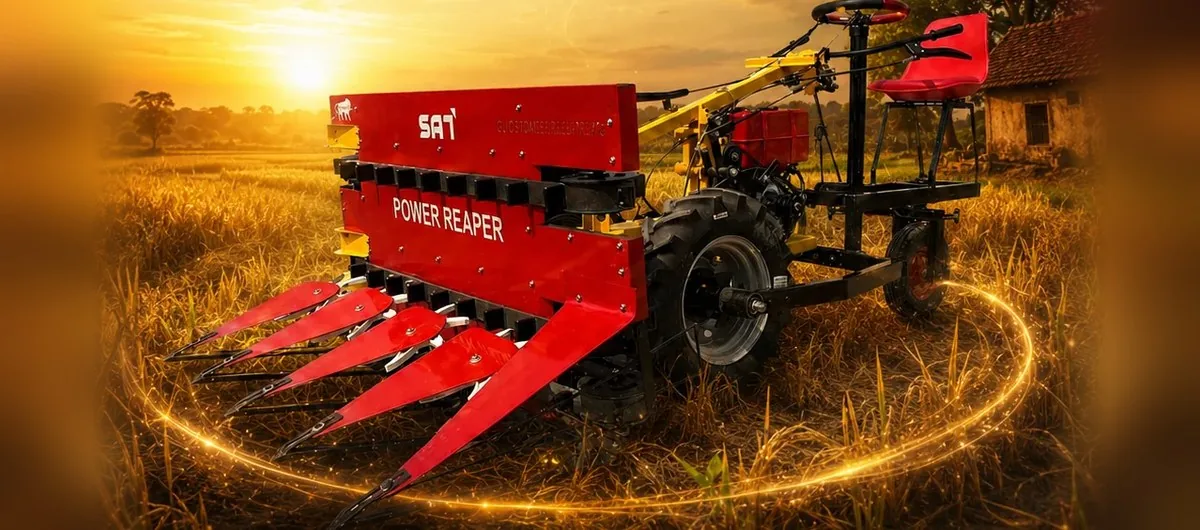


Both machines below are Sunidhi Agrotech reapers, sold in Hindi as the Jadui Katar (जादुई कटर) and the Laal Katar (लाल कटर). The names describe the range, not one model — what follows is how the two drives actually differ.
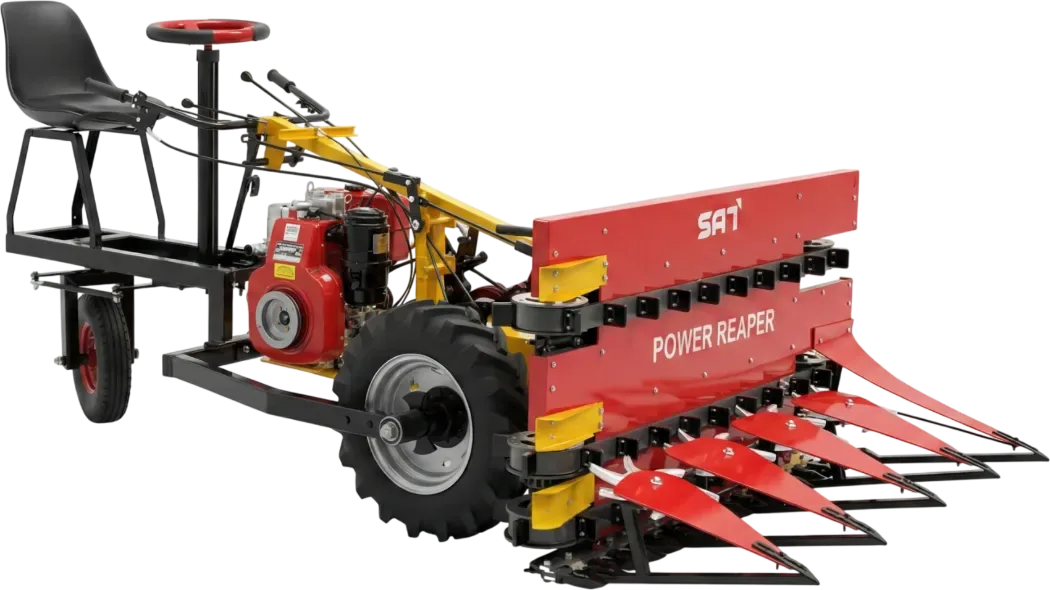
Two reapers, same 5 HP engine, same cutter bar, similar output on paper. Yet on some farms one of them is a pleasure to run and the other is a wrestling match. The difference is the differential — and whether your fields need it.
What a differential actually does
On a standard reaper, both drive wheels turn together. Straight-line work is fine. But when you turn, the outer wheel needs to travel further than the inner one — and because they are locked to the same speed, one of them has to scrub sideways across the ground. That resistance is what you feel in your arms at every headland.
A differential lets the two wheels turn at different speeds. The outer wheel runs faster through the turn, the inner wheel slower, and neither has to skid. The machine pivots instead of fighting.
Our SAT-R201 adds a differential lock as well, which is the other half of the story: you can lock the wheels together on demand for traction in soft or wet ground, then unlock for the turn. You get both behaviours from one machine.
The short version: a differential is about turning. If your fields are large, square and open, you turn rarely and it matters little. If they are small, irregular or terraced, you turn constantly and it changes the entire day.
Count your turns, not your acres
This is the practical test, and it is more useful than any spec sheet.
Picture a long, rectangular five-acre block. You make a few long passes and turn at the ends — perhaps a couple of dozen turns for the whole field. Now picture five separate one-acre plots with bunds, irregular corners and a tree in the middle of one. Same total area, several times as many turns, and every one of them in a tighter space.
A standard reaper handles the first field perfectly well. The second field is where a differential earns its cost — every single turn, all day.
Where each machine belongs
A standard self-propelled reaper (SAT-R101 / R102) suits:
- Larger, regularly shaped fields with long uninterrupted runs
- Farms where most work is straight-line cutting
- Firm, level ground
- Buyers wanting the simplest, most economical machine that does the job
A differential reaper (SAT-R201) suits:
- Small or fragmented holdings — several plots rather than one block
- Irregular field shapes, bunded plots, awkward corners
- Soft, wet or uneven ground where the lock helps traction
- Long working days where operator fatigue decides how much gets cut
- Custom-hire operators working many different farms in a season
Differential vs standard reaper: side by side
Both machines share the same 5 HP engine, the same cutter bar and the same 4 cm minimum cut height. Every meaningful difference comes down to how the two drive wheels behave when you turn.
| Factor | Standard reaper (SAT-R101 / R102) | Differential reaper (SAT-R201) |
|---|---|---|
| Engine | 5 HP self-propelled | 5 HP self-propelled |
| Minimum cut height | About 4 cm | About 4 cm |
| Drive wheels | Both locked to the same speed | Turn at independent speeds |
| Differential lock | Not fitted | Fitted — lock on demand for traction |
| Behaviour in a turn | Outer wheel scrubs sideways; resistance at every headland | Machine pivots; neither wheel skids |
| Best field shape | Large, regular, open blocks with long runs | Small, fragmented, irregular or bunded plots |
| Ground conditions | Firm and level | Soft, wet or uneven — the lock helps traction |
| Crops handled | Wheat, paddy, barley, jowar, bajra, fodder maize, mustard, chana and more | Same crop range |
| Best suited to | Straight-line cutting; the simplest, most economical machine that does the job | Many turns per day, long working days, custom-hire operators across many farms |
| Built and tested | Fabricated, assembled and load-tested in Ahmedabad | Fabricated, assembled and load-tested in Ahmedabad |
| Operator training | Free on delivery | Free on delivery |
Fatigue is an output number
It is tempting to treat operator effort as a comfort issue. On a harvest day it is a capacity issue.
An operator wrestling a locked-wheel machine through two hundred tight turns is measurably slower by the afternoon than one running a machine that turns easily. The acres you actually cut in a day depend on the operator still being effective at four o'clock — not on what the machine can do in the first hour.
The same logic is why the seating attachment exists, and why the two pair so well. A differential machine with a seat is a fundamentally different working day from a walk-behind standard reaper — we cover that in why a reaper with a seat changes harvest days.
What stays the same between them
Both are 5 HP self-propelled machines. Both cut low — down to about 4 cm — which is what protects your straw recovery. Both handle the same range of crops: wheat, paddy, barley, jowar, bajra, fodder maize, mustard, chana and more. Both are fabricated, assembled and load-tested in our Ahmedabad plant, and both come with free operator training on delivery.
You are not choosing between a good machine and a compromised one. You are choosing which behaviour your land needs.
Honest advice on cost
The differential machine costs more. A differential and lock are real mechanical additions, not a trim level.
If your fields are large and open, that extra money buys you very little, and we will tell you so. If your fields are small and irregular, it is likely the best money in the whole purchase — because it is spent on the part of the job you do most.
For a full breakdown of what moves a reaper quotation — engine, belts, seating, subsidy — read our power reaper price guide.
Still not sure?
Tell us the shape and size of your plots, not just the total acreage. That one detail decides this question more reliably than anything else. Send us your field details or check the nearest dealer on our network page and see both machines working before you decide.