There is no single best reaper, but there is a best one for your field. Here are the models worth shortlisting for each situation, with maker-published specs, listed prices from October 2026 and the subsidy rules, so you can compare like with like.

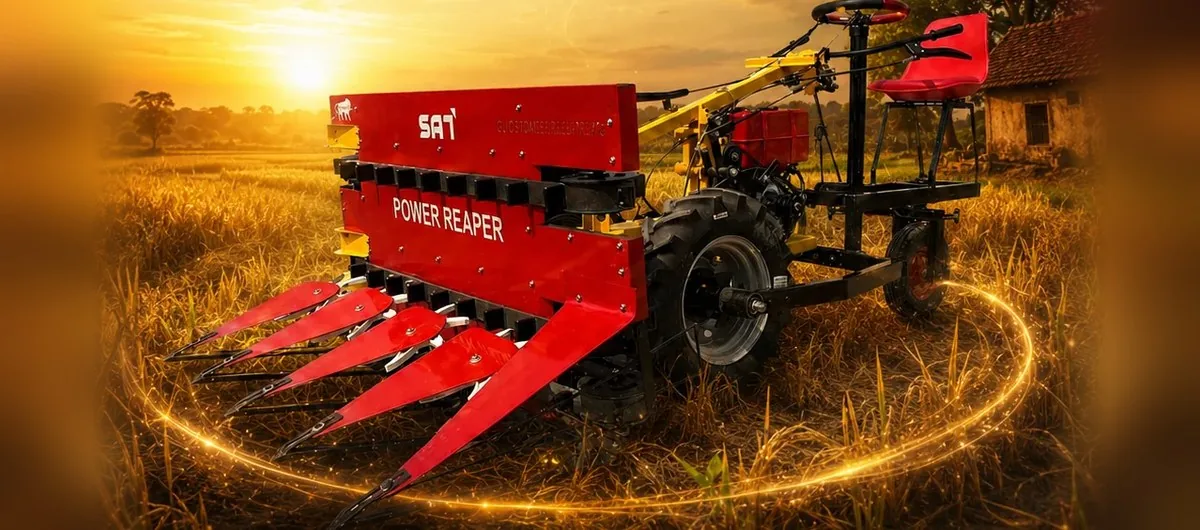
Quick answer. The best reaper for you depends on three things, not on a brand: whether you own a tractor, how big and regular your plots are, and how tall your crop stands. As a rule: no tractor and 2–20 open acres → a self-propelled walk-behind reaper (about ₹1 lakh to ₹1.75 lakh); constant turning on small bunded plots → a differential drive with lock; long harvest days → a seat; a 30–60 HP tractor in the shed → tractor-mounted (from about ₹60,000); crop tied in bundles → a reaper binder (₹2.45 lakh to ₹3.79 lakh). Prices are listed prices seen on 5 Oct 2026.
No single machine wins every field, so we list the models worth shortlisting for each situation, A to Z, rather than naming one “best”. Specs come from the makers’ own pages where they exist; where they do not, the page says so.
| Your situation | Type to look at | Models to shortlist (A to Z) | Listed price | Check before you buy |
|---|---|---|---|---|
| No tractor free at harvest; open plots of about 2–20 acres; daily or hire use | Self-propelled walk-behind, diesel | Balwaan PR-900; KisanKraft KK-SPR-1202D; RBD-PR-D; Sunidhi SAT-R101 | ₹1,10,000–1,60,000 | 3-belt or 2-belt drive for tall crop, fuel per hour, spares |
| Own 2–5 acres; lighter, cheaper machine | Self-propelled walk-behind, petrol | Greaves GPR 120; KAMCO KR 120 H; KisanKraft KK-SPR-1201P; Krishitek Reaptek Ki-120; Shrachi 4R-P; Sunidhi SAT-R102; VST Shakti 5PR | ₹1,30,000–1,60,000 | Engine make, cutting width, weight you can lift and turn |
| Long harvest days; you want to sit | Seat-type (ride-on) | RBD seat models (RBD-PR-S to RBD-SSPRD10); Sunidhi SAT-S701 seat kit on a SAT walk-behind reaper | ₹1,20,000–1,51,000 complete (RBD); kit ₹25,000–30,000 | Is the seat in the quoted price; steering or foot-lever |
| Small, bunded or terraced plots with constant turning | Differential drive with lock | Sunidhi SAT-R201. Ask other makers whether they offer a lock. | ₹1,35,000–1,65,000 | Demo on your own plot |
| Wet paddy | Wheeled walk-behind petrol reaper listed for paddy | Krishitek Reaptek Ki-120; KisanKraft KK-SPR-1201P; Shrachi SPR 1200 paddy reaper. See our paddy reaper page. | ₹1,35,000–1,75,000 | Demo in a wet field. We did not find a tracked (crawler) reaper on the Indian makers’ pages we read. |
| You own a 30–60 HP tractor and have larger area | Tractor-mounted | Krishitek Reaptek T6 / T7; Mahindra Vertical Conveyor Reaper; Sardar 4–9 ft reapers; Vasundhara VKY-VCR series | From about ₹60,000 to ₹1,51,200 | Tractor HP, PTO or hydraulic drive |
| You need the crop cut and tied in bundles | Reaper binder | BCS India Reaper-Binder; Jagatjit JRBFTA; Khedut KARB 02; Sardar reaper binder | ₹2,45,000–3,79,000 | Twine cost, tractor or self-propelled version |
Sunidhi Agrotech makes some of the machines listed, and we have placed them by the same rules as the others. Full maker details, with sources, are on our top 10 reaper manufacturers page.
| Model | Engine | Cutting width | Weight | Capacity as stated | Listed price (source) |
|---|---|---|---|---|---|
| Balwaan PR-900 | 5 HP Greaves diesel | 4 ft | 210 kg | 4–5 bigha per hour | ₹1,32,000 (maker) |
| Greaves GPR 120 | 5.0 HP petrol, OHV | 1,200 mm | Not on maker page | Not stated | ₹1,40,000 (dealer) |
| KAMCO KR 120 H | Honda GX160 petrol, 3.89 hp rated | 120 cm | 138 kg | 1.2–1.8 hours per acre | ₹1.35–1.55 lakh (marketplace) |
| KisanKraft KK-SPR-1201P | 212 cc petrol | 120 cm | Not stated | 0.241–0.297 ha/hr (about 0.60–0.73 acre/hr) | ₹1,49,800 (maker) |
| Krishitek Reaptek Ki-120 | Honda petrol, up to 4.8 HP | 4 ft | 130 kg | About 0.53–0.61 acre/hr (TractorJunction); 1 acre/hr (own store) | ₹1,35,000 (own marketplace store) |
| RBD-PR-D | 5 HP Greaves diesel | Not stated | Not stated | About 1 acre per hour | ₹1,10,000 (RBD store) |
| Shrachi 4R-P | Petrol, 5.5 HP | 4 ft | 120 kg | 0.7 acre per hour | ₹1,50,000 (maker, state-specific) |
| Sunidhi SAT-R101 | 5 HP Greaves diesel | Not stated on product page | 250 kg | About 1 acre per hour | ₹1,30,000–1,60,000 (maker) |
| Sunidhi SAT-R102 | 5 HP Honda GX200 petrol | Not stated on product page | 230 kg | About 1 acre per hour | ₹1,30,000–1,60,000 (maker) |
| VST Shakti 5PR | Honda GX160 petrol, 5 HP | 1,200 mm | 135 kg | 1.2–1.8 hours per acre (about 0.56–0.83 acre/hr) | ₹1,55,000 (dealer) |
Capacity figures are as stated by the maker or, where noted, by an aggregator, and were measured in different conditions, so compare with a demonstration, not a table. Conversions to acres per hour are ours. Listed weights run from 120 kg to 250 kg; check yours against how you will turn, load and transport the machine.
In the table, the diesel machines are listed at 210–250 kg and the petrol machines from most makers at 120–138 kg (our own petrol SAT-R102 is 230 kg). Diesel is the usual choice for long daily use and for hiring the machine out, because of its lower running cost per acre; our SAT-R101 burns about 0.8–1.0 litre an hour, and its 3-belt drive is rated for standing crop up to 10 ft. If you cut your own 2–5 acres a season, a lighter petrol machine is the common pick. Whichever you choose, ask for the fuel use per hour in writing.
A seat spares the operator a day of walking behind the machine, and several makers offer one. Check whether it is a complete model or a kit, whether the quoted price includes it, and whether you steer with levers or a wheel. A differential with lock matters only if you turn a lot: on small bunded or terraced plots it stops the machine dragging at every headland. On long open plots you can do without it. Our differential vs standard guide and reaper-with-seat guide explain both.
The national Sub-Mission on Agricultural Mechanization gives 50% of machine cost to small and marginal farmers, SC/ST farmers, women farmers and farmers of the North Eastern and Himalayan regions, and 40% to others, subject to a cap. For a self-propelled crop reaper (diesel, petrol or battery) the cap is ₹0.85 lakh at 50% and ₹0.68 lakh at 40%; a three-wheel reaper-cum-binder is ₹1.92 lakh and ₹1.54 lakh and a four-wheel one ₹2.60 lakh and ₹2.08 lakh. As an example of the arithmetic, a ₹1,40,000 reaper would attract ₹70,000 at 50% and ₹56,000 at 40%, both below the caps — but your state decides, and it pays against machines with a valid test report that are on its list. Source: SMAM Operational Guidelines 2026 (revised August 2026). GST on harvesting machinery fell from 12% to 5% from 22 September 2025 (GST Council press release). For Gujarat see our subsidy roadmap.
A straw reaper collects residue as bhusa after a combine has harvested the grain; it does not cut standing crop. A combine harvester cuts, threshes and cleans in one pass and costs several lakh rupees more. A reaper cuts and lays the crop in a windrow for later threshing, which keeps the straw whole as saleable bhusa. For the arithmetic between reaper, combine and hired labour, read our wheat harvesting guide.
To compare prices across our own models see the price list; the price guide shows what moves a quotation.
Method: model data were read from the makers’ own pages, or from the dealer or marketplace page named next to the figure, on 5 Oct 2026. Questions or corrections: info@sunidhiagrotech.com.
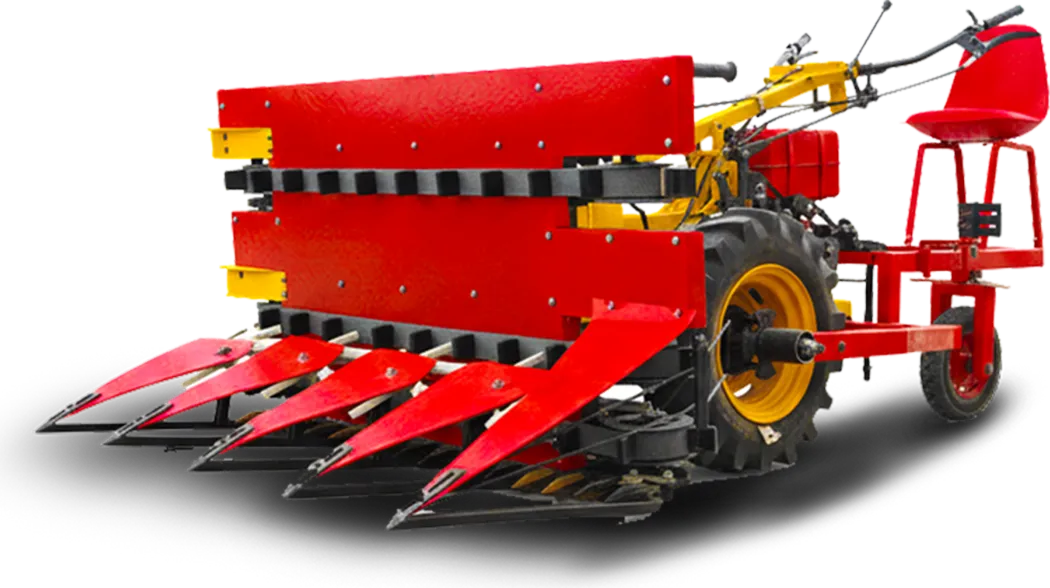
Ten makers that publish a crop reaper with specs, listed A to Z with base, models, listed prices and what could not be verified.
Combine, reaper or labour gangs? The honest arithmetic for 2-20 acre wheat farms before the rabi rush begins.
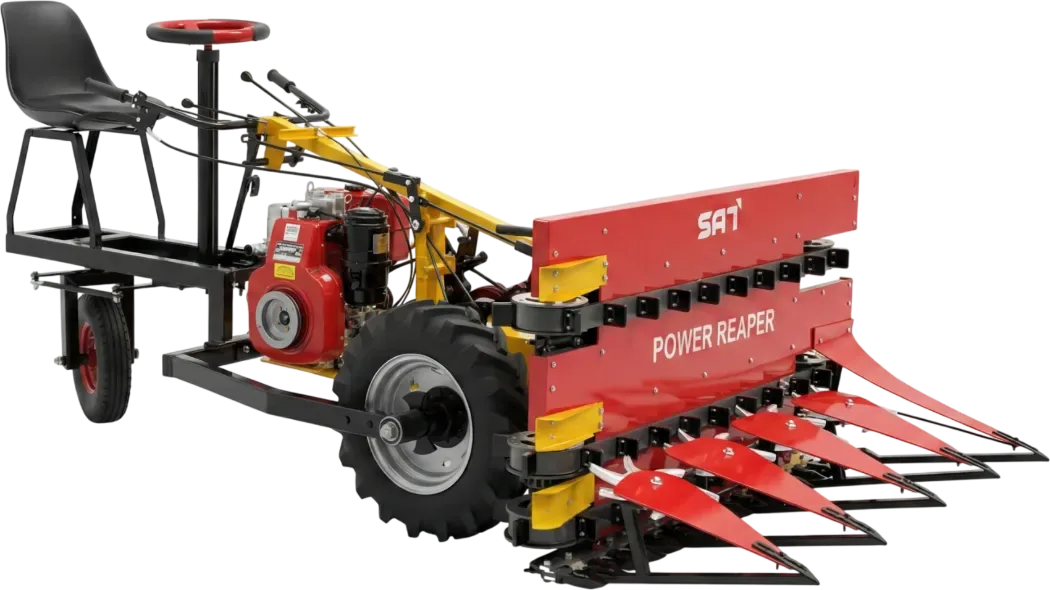
How differential drive changes turning, operator effort and daily output - and which reaper suits your land.
Tell us your crop and acreage — get an honest recommendation, a factory-direct quote and subsidy guidance in one call.